Syft Detect
Find AI writing. See exactly where.
Syft Detect reads a draft, reports a signal band, and marks the passages behind it with the pattern in each one, then gives you the tools to refine the writing and check the result again.
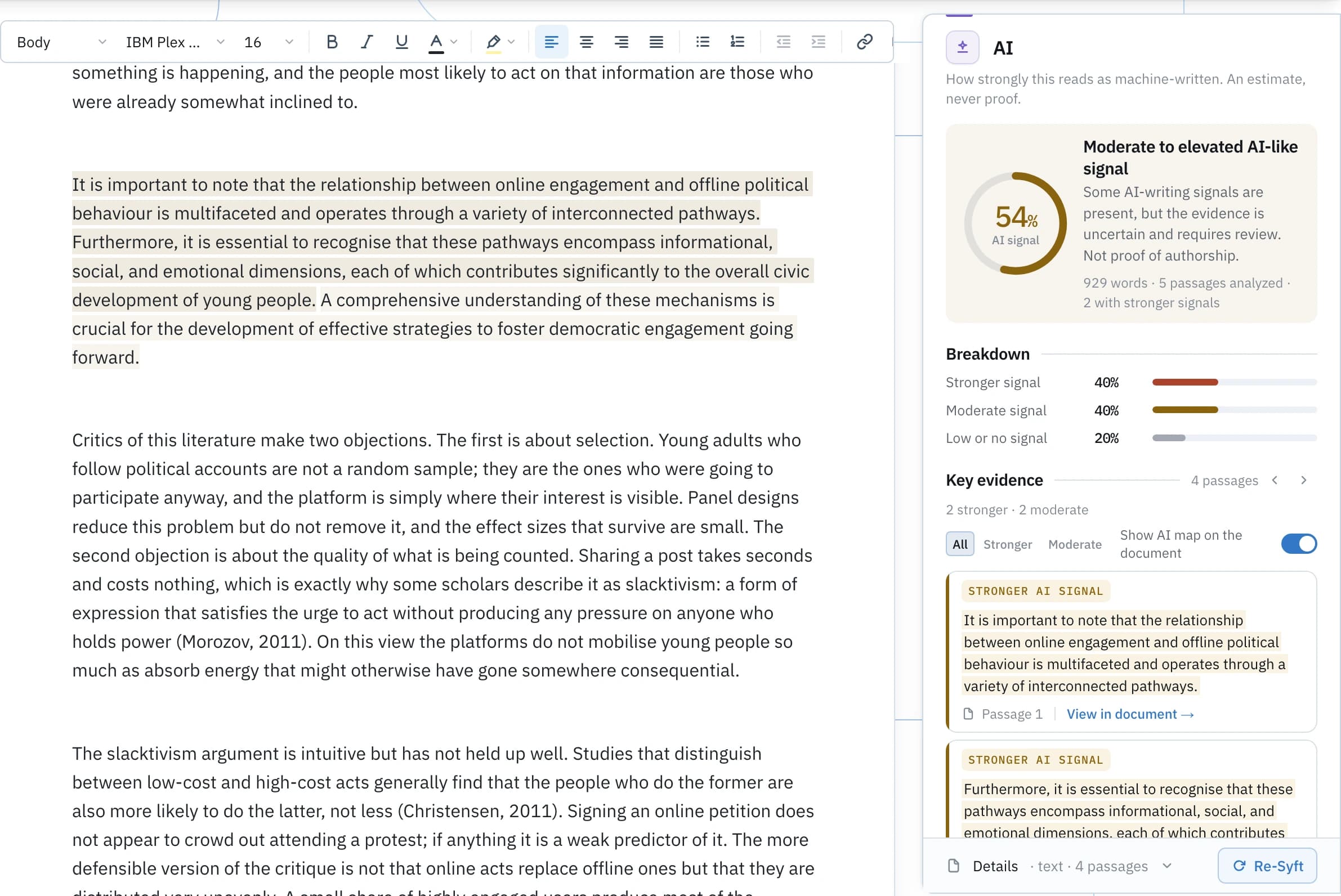
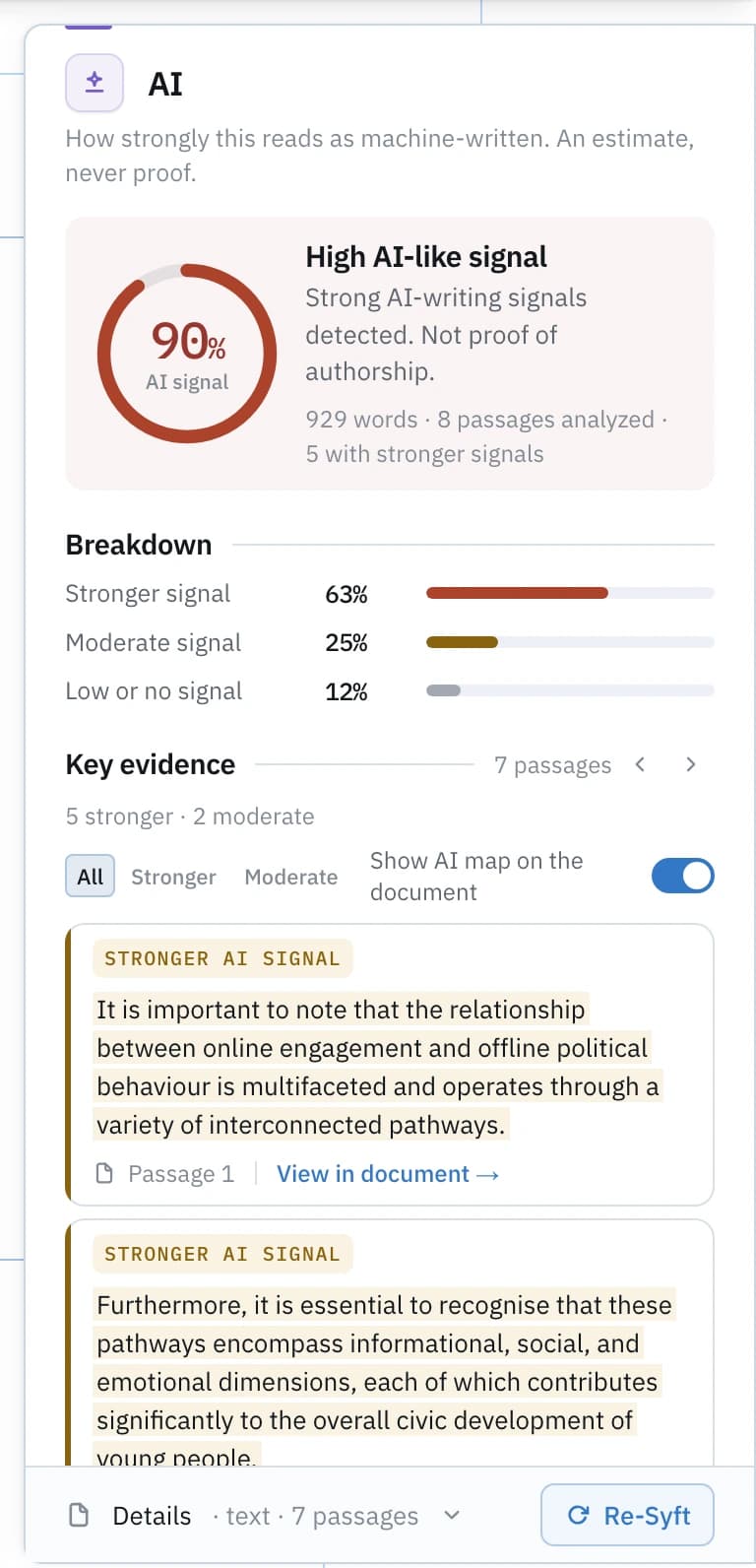
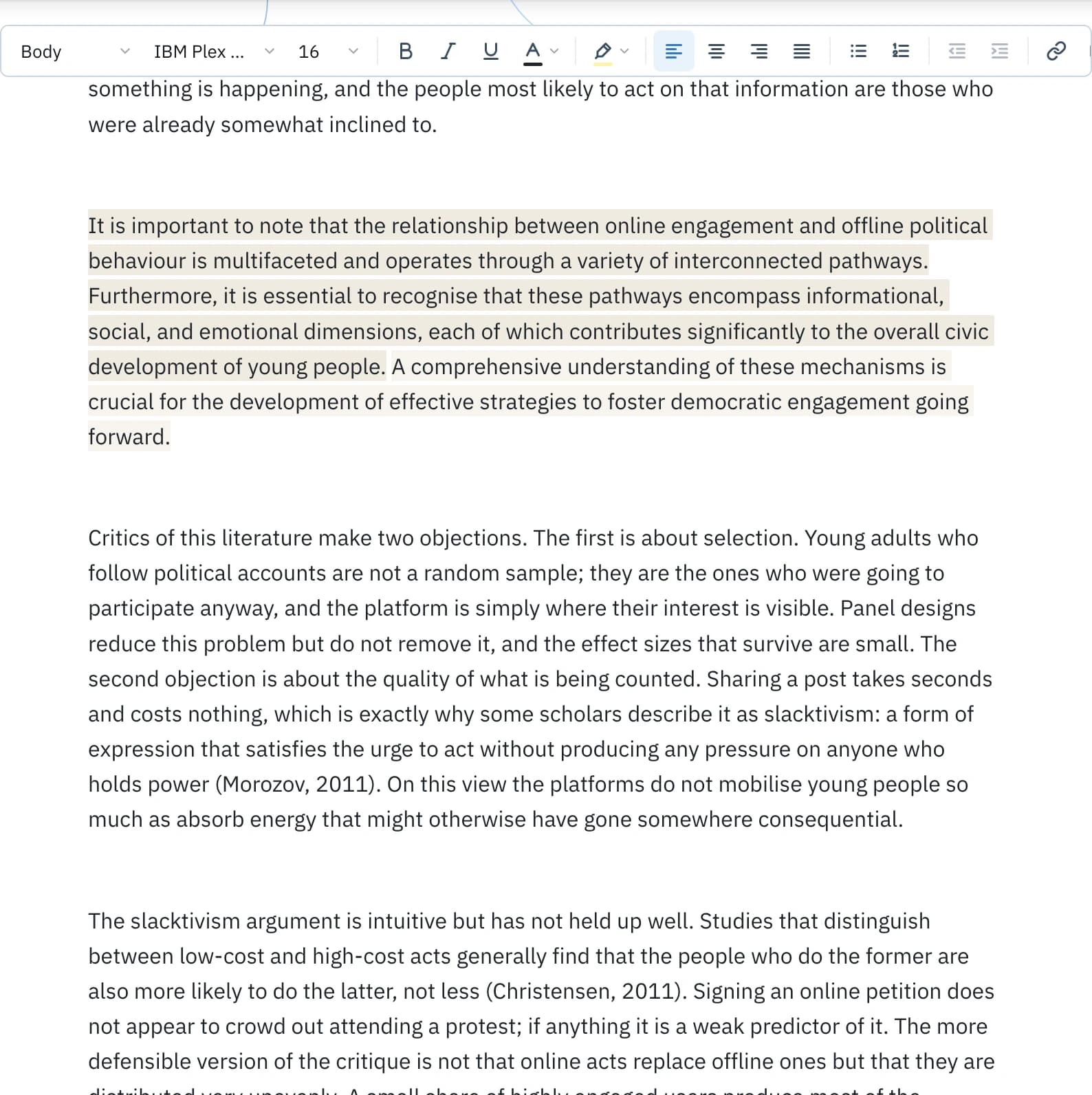
The AI map
See where the signal comes from.
Syft marks the contributing passages on the document itself, each with the reason behind its reading: formulaic transitions, uniform sentence length, templated cadence. The band at the top is the summary; this is what produced it.
Mixed writing gets mixed evidence, not one binary label: the content breakdown separates AI-like, uncertain and human-like portions, and every passage can be reviewed on its own.
Tested across major generative AI systems
Tested across major generative AI systems.
Syft evaluates AI-writing signals across outputs from leading model families, rather than relying on examples from a single provider.
These are the model families Syft evaluated against. They are not partners, customers or endorsers, and performance is not uniform across them: some families are missed more often than others.
See how Detect is evaluated, and where it is weakestReading the result
What each band means.
Syft reports one band for the text as a whole, in plain words, and then shows the passages behind it. The band says how strongly the writing carries AI patterns; the evidence says where.
Low signal
the measured patterns sit mostly in the range associated with human drafting.
Moderate to elevated
AI signals are present and worth reading. The marked passages show you which.
High signal
strong AI signals across the text, with the evidence marked in place.
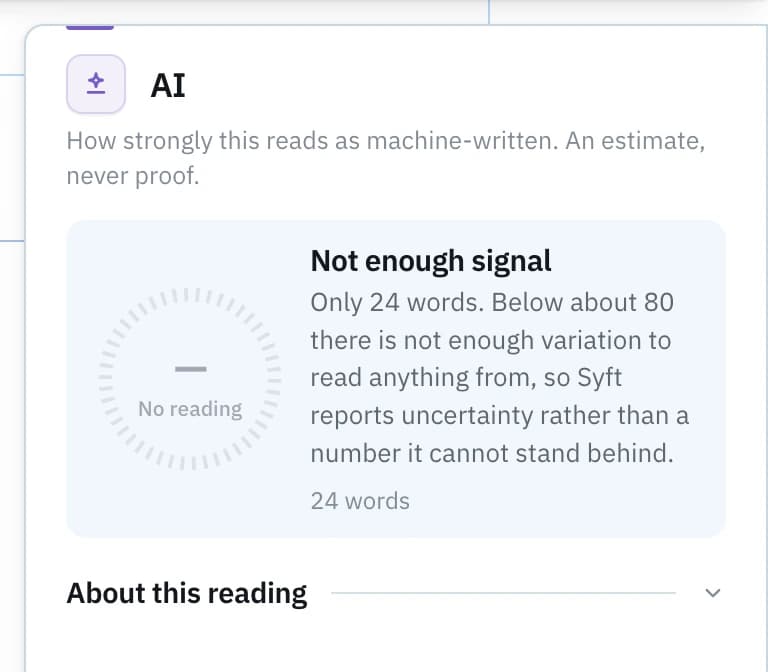
Insufficient signal
too little text to read anything from, and Syft says so.
A detector result is not proof of authorship. A band is a reading of the writing, to be weighed with everything else you know about the draft.
What comes back
A result, and the evidence under it.
One analysis produces both. The band tells you how the draft reads as a whole; the marked passages tell you which sentences put it there, and what pattern each one carries.
The result
- A signal band for the text as a whole, in plain words
- A content breakdown: AI-like, uncertain and human-like portions
- Insufficient signal when there is too little text to read
- Built for essay and academic prose in English
The evidence
- Every contributing passage marked on the document itself
- The pattern behind each one: phrasing, cadence, sentence variation
- Sentence variation, phrasing, punctuation and vocabulary, measured
- One exportable record of what ran and what it found
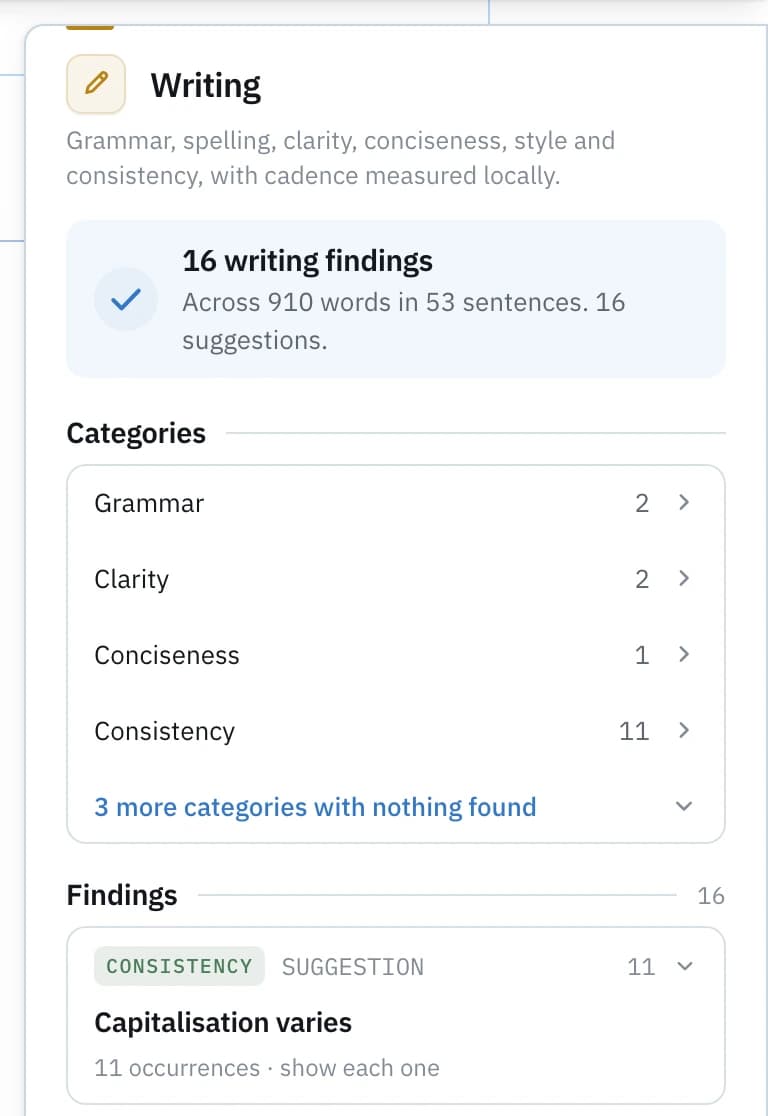
Writing signals
Context around the signal.
Beside the band, the Writing lens measures the prose itself: sentence variance, lexical diversity, cadence. Human writing usually swings; uniform rhythm is one of the signals Syft weighs most heavily.
These are measurements you can read directly. They tell you how the text moves, and which of its habits carried the signal.
Improve · Humanize
Improve the writing, not the score.
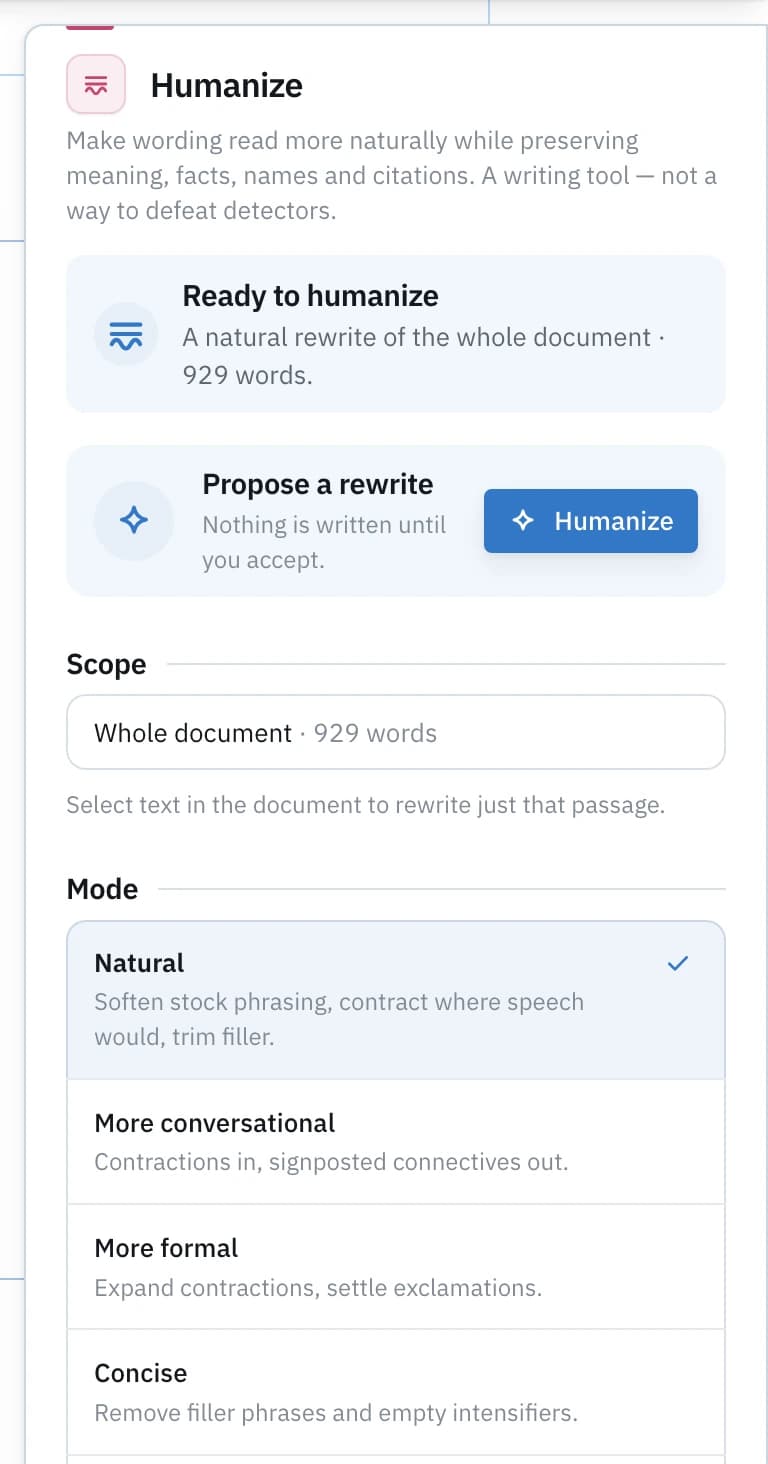
When the evidence points at stiff, formulaic prose, the fix is better writing. Improve and Humanize propose word- and phrase-level revisions: proposals you review, never silent rewrites.
- Improve
- Clarity edits from Syft's writing measurements: over-long sentences, heavy signposting, filler. Reviewed one by one.
- Humanize
- Make wording read more naturally while preserving meaning, facts, names and citations. A writing tool — not a way to defeat detectors.
Those descriptions are the product’s own words. Quotes, numbers and citations are verified preserved, and everything is written to a new copy. Your original stays untouched.
The workflow
Understand. Refine. Check again.
Syft treats AI review as a workflow, not a one-shot verdict: read the evidence, improve the writing where you choose, and see how the evidence changes.
01
Understand the signal.
The AI map shows which passages carry it, and why: evidence with a location.
02
Refine where you choose.
Improve and Humanize propose revisions toward clearer, more natural writing. You accept or reject each one.
03
Check the result again.
Re-Syft the draft, compare versions, and read the record of what changed. The evidence updates with the writing.
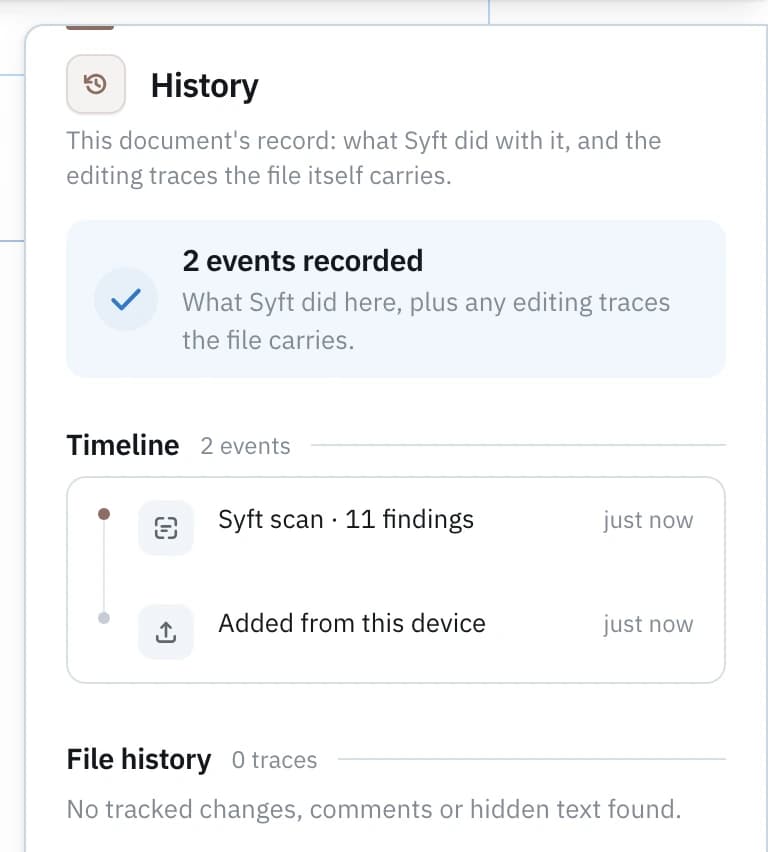
Also in the workflow
- Compare: two versions diffed across text, metadata and structure at once.
- Stale detection: results that no longer match the bytes say so; a detection never looks current when the content moved on.
- Re-Syft: one action to run the full analysis again on the current text.
Scope
Built for essay and academic prose.
Syft Detect is calibrated on the kind of writing people are actually judged on: coursework, essays, reports, long-form drafts in English. It says when a text falls outside that.
What it reads
Essay and academic prose in English: coursework, reports, articles and long-form drafts, whether pasted in or opened from a document.
Where it holds back
Very short text, fragments and lists, code, and writing in other languages. Syft reports insufficient signal instead of a reading it cannot stand behind.
Syft Detect runs on every scan. Text needed for detection is sent once over an encrypted connection to Syft's own servers, is never used to train a model or shared with anyone, and is deleted shortly after the result reaches the Syft workspace. How Syft handles your files
Who it's for
Anyone whose writing gets judged.
- Students: review a draft before submission. Syft for students
- Academic writers: see how an essay-style draft reads, passage by passage, before it goes anywhere.
- Reviewers and editors: weigh essay and long-form prose against the passages and the pattern behind each one, not a single number.
Pricing
The evidence is free.
Free
$0
- Syft Detect, with the evidence behind every reading
- The AI map, Improve and Humanize
- Writing analysis and the full inspection
Pro
$14.99/ month
or $149 / year
- 50,000 Syft Credits a month
- Larger files from connected sources
- Everything in Free
Questions
Straight answers about AI detection.
- What does Syft Detect give me?
- A signal band for the text as a whole (low, moderate to elevated, or high) and the passages that put it there, each marked in place with the pattern behind it. Syft Detect is built for essay and academic prose in English.
- Does Syft give an AI percentage?
- Syft reports a 0–100 signal index, the band behind it (low, moderate to elevated, or high), and the passages that carry the pattern. The index is Syft's presentation of how strongly the writing reads as machine-written — it is not a probability that AI wrote the text, not proof of authorship, and not an accuracy figure. Syft publishes no accuracy or false-positive rate of its own.
- Can Syft prove text was written by AI?
- Syft measures how strongly writing carries the patterns of machine-generated text, and shows you the passages behind that reading so you can judge them in context. A detector result is not proof of authorship. Syft reports it as evidence to review, and never as a verdict.
- Why can human writing get flagged?
- Syft measures patterns, not authorship. Confident, uniform, formulaic prose carries some of the same patterns as machine-generated writing. That is why every reading comes with its passages: you can see exactly what was marked, and why, and weigh it against what you know about the draft.
- What is AI highlighting?
- The AI map draws the evidence directly on your document: passages associated with AI-like patterns are marked in place, each with the reason behind its reading, so the signal has a location instead of just a score.
- Does Humanize make writing undetectable?
- No, and it isn't offered for that. The product says so on the panel itself. Humanize is writing refinement: it proposes more natural wording while preserving meaning, facts, names and citations, and you review every change before anything is written.
- Can Syft analyze short text?
- Syft needs a few paragraphs to read anything dependable. Below that floor it reports 'not enough signal' rather than inventing a reading it cannot stand behind.
- Does Syft send my writing to another AI provider?
- Syft Detect is operated by Syft. Text needed for detection is sent once over an encrypted connection to Syft's own servers, is never used to train a model or shared with anyone, and is deleted shortly after the result reaches the Syft workspace. See Security and Privacy for how processing and retention work.
After the result
A signal is a place to look, not an instruction.
Detect marks the passages and names the pattern behind each one. What you do next is yours — and if a passage does read as formulaic to you too, Humanize revises that passage without touching the rest of the draft.
Detect identifies
Which passages carry AI-writing signals, how strong each one is, and the measured pattern that produced it.
Humanize revises
The same passages, a span at a time, with every proposal shown before anything changes.
Part of Syft
Four capabilities, one workspace.
They read the same document and the same analysis, so a signal you find in one is the passage you revise in another.
See the whole workspace — documents, metadata, provenance and code as well as writing.
See the evidence behind the signal.
Free to check text. Sign in if you already have an account.