How to prove you didn't use AI
The record around a document is what shows how it came to be: version history that grows across sessions, dated drafts, notes that precede the writing, and what the file itself stores. Here is what each source can show, what it cannot, and how to inspect yours. A detector reading, high or low, is not proof in either direction.
Published Syft
Evidence sources
Six kinds of record, and what each can carry.
Strength comes from combination. A version history that grows over days, drafts that develop an argument, notes that precede the draft, and a file whose record agrees with all of it.
Version history
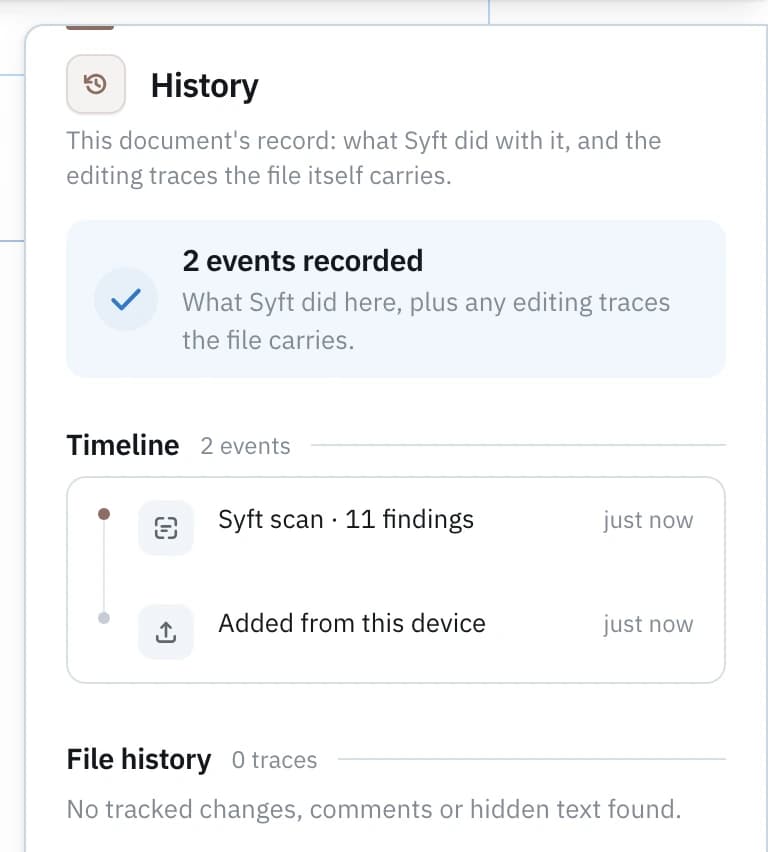
Word, Google Docs and similar tools record edits over time. A history that shows a document growing across sessions is the single most persuasive record. Its limits: it can be absent, it does not show what was pasted in, and it shows edits, not thought.
Drafts
Dated earlier versions saved as separate files. They show development: an outline, a rough draft, a revision. Their limit: dates are set by the computer's clock and are easy to question on their own.
Source notes and reading
Notes, highlights, saved articles, a bibliography built as you went. They show research preceded writing. Their limit: they show what you read, not what you wrote.
File metadata
A document records an author field, creation and modification times, revision counts and editing time; a PDF records its creator and producer. Their limit: fields name a computer profile, can be edited or templated, and can be absent.
Writing-process records
Messages with a tutor, an outline shared with a peer, a submission portal's timestamps. They corroborate the timeline from outside the document.
The writing itself
Your voice, your examples, your errors and corrections. A reader who knows your other work can recognise it. A detector cannot, and its reading is not evidence of authorship either way.
Inspect your document
See what your file records about itself.
Read the PDF's own record (title, author, creator application, producer and dates) on the PDF metadata viewer. For a Word document, the Syft workspace reads the author, application, timestamps, revision count and editing time the file carries, and grades what that exposes.
Read a PDF’s metadata
Title, author, creator application, producer, dates and page count — the record the file carries with it. No account needed.
Inspect PDFRead a .docx’s record
Author, application, created and modified times, revision count and editing time, with the privacy exposure graded. In the Syft workspace, with a free account.
Inspect a Word document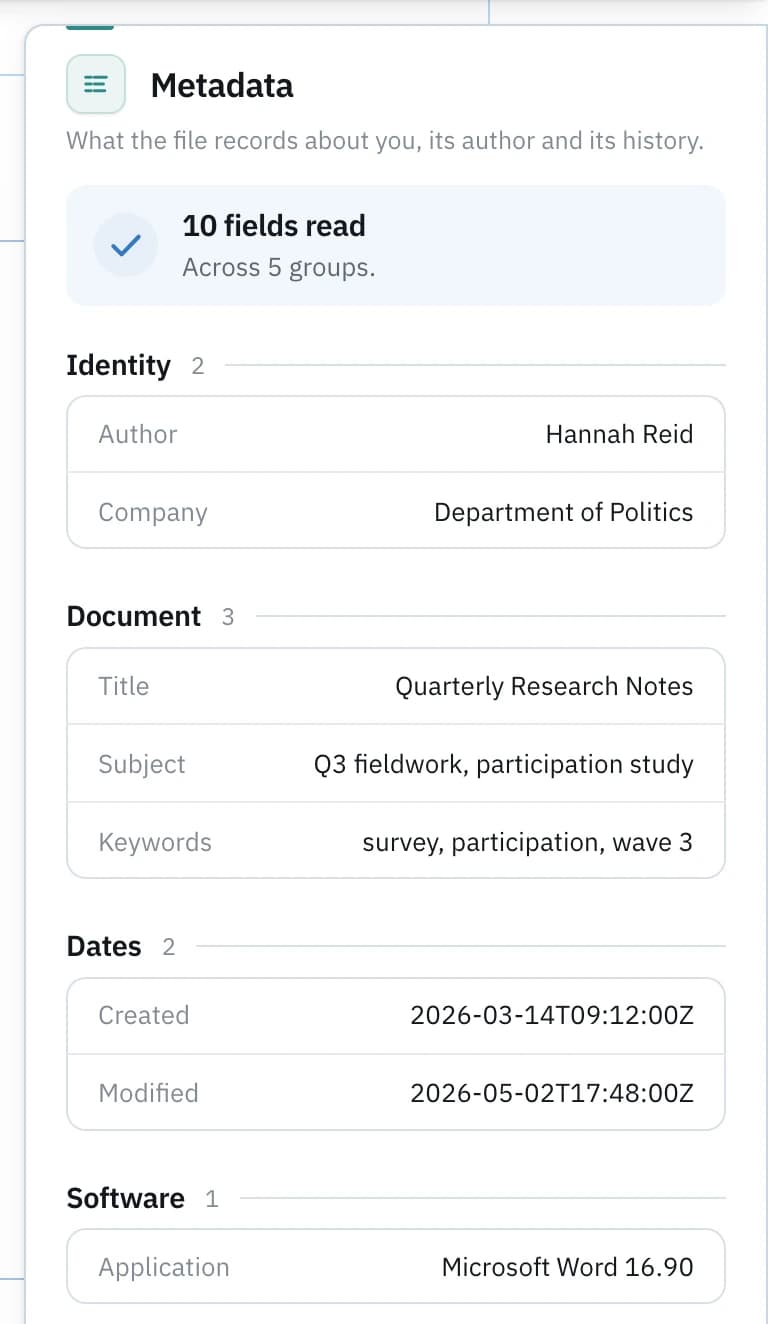
Assembling the record
A workflow for showing how a document came to be.
- 01
Export the version history
In Google Docs, open the version history and name the key versions; in Word, keep the file's own history and any earlier saved copies. Screenshots with dates are fine; the original files are better. - 02
Line up your drafts
Order them by date. Note what changed between each: outline to draft, draft to revision. Development is the story. - 03
Collect what preceded the writing
Reading notes, saved sources, an annotated bibliography, an outline. Anything dated before the first draft. - 04
Inspect the final file
Check what it records: author, application, created and modified times, revision count, editing time. Make sure the record agrees with your timeline, and know what it does not show. - 05
Add outside corroboration
Messages about the work, a tutor's feedback on a draft, portal timestamps. Records other people hold carry weight. - 06
Present it as a timeline
One page: dates down the side, evidence beside each. Lead with the strongest source, usually version history, and be plain about gaps. A credible account is not a perfect one.
Read it honestly
No artefact is conclusive. The account is.
Every source above can be questioned on its own: a clock can be wrong, a field can be edited, a history can be thin. That is why the record is assembled rather than picked. Several independent sources that agree are hard to dismiss; one source that stands alone is easy to.
A detector reading belongs in the account as context: it describes the writing’s resemblance to generated text on measured features, and the marked passages show where. It cannot testify to how the text was made, which is what the record above is for.
OBSERVEDIndependent research finds detectors as a class produce false positives on human writing and lose accuracy on edited text; that is why process evidence, not a reading, is the appropriate basis for a decision about a person.
References
- 01Testing of detection tools for AI-generated text Weber-Wulff et al., 2023 · International Journal for Educational Integrity · 2023
Questions
About process evidence.
- Can any single piece of evidence prove I wrote something?
- No. Each source shows part of the process: a version history shows growth over time, drafts show development, notes show research, metadata shows what the file records. Together they make a credible account of how the work came to be. None of them is conclusive alone, and Syft does not claim otherwise.
- Does file metadata prove authorship?
- No. Metadata records what the writing application stored: often an account name, timestamps and revision counts. It can be edited, copied from a template, or missing, and it names a computer profile rather than a person. It is context, not proof.
- What if I wrote in a tool with no version history?
- Keep what you have: dated drafts saved as separate files, notes, sources and correspondence about the work. Going forward, writing in a tool that records history, or saving dated copies, gives you the strongest record.
- Should I run my essay through a detector to defend it?
- It is useful for one thing: seeing which passages a detector reacts to, so you can explain them in your own words. It cannot certify the essay as yours, and a low reading is not proof any more than a high one is. The record of your process is what carries the account.
- Is this legal advice?
- No. Academic and workplace procedures differ; your institution's policy and appeals process are the authority. This page describes evidence sources and how to inspect them.